Thursday, March 30, 2017

Gravity- Helicopter Experiment.

 Gravity

https://www.youtube.com/watch?v=mn34mnnDnKU

Newton has 3 Laws of Motion.


1. An object at rest will remain at rest unless acted on by an unbalanced force. An object in motion continues in motion with the same speed and in the same direction unless acted upon by an unbalanced force.


2.Acceleration is produced when a force acts on a mass. The greater the mass (of the object being accelerated) the greater the amount of force needed (to accelerate the object).

3. For every action there is an equal and opposite re-action.


Aim: To make a helicopter and look at the force of gravity.

Hypothesis: The size of the wings will effect the speed that the helicopter travels.

Equipment:
  1. Stopwatch - use the Google stopwatch on your Chromebook
  2. Helicopter template / paper
  3. Drawing pin


Method:


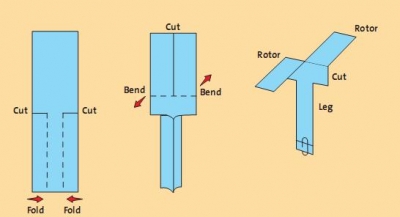
Image result for how to make a paper helicopter


  1. Make the helicopter by cutting out the template.
  2. Drop the helicopter from a height. Use the same person.
  3. Time each drop and record the time when it hits the floor.
  4. Each time it is dropped you will make a change to its form.

  • With a paperclip on the bottom.
  • Use heavier material ( Cardboard)
  • Cut the body in half to give it a short body.
  • Cut the wings to give it short wings
  1. Time each time you drop it.
  2. Record the findings on a chart
TypeTime
Paperclip1.50 seconds
Cardboard1.16 seconds
Short wings1.85 seconds
short body1.34 seconds  
The one with a paper clip flew for 1s and 50mm and the cardboard one flew for 1s and 16mm,
The one with short wings flew for 1s and 85mm and the on with a short body flew for 1s and 34mm.


Tuesday, March 28, 2017

Paper Planes

There are 4 forces:
1.Thrust
2.Lift
3.Drag
4.Gravity


Making a paper plane

Q. What are the forces acting on a paper plane?

There are 4 forces acting on a paper plane.


Thrust pushes the plane forward
Lift pushes the plane up.
Gravity (or Weight) pulls the plane down.
Drag pushes the plane backwards.


Challenge:  To find a paper plane that beats the rest of the class.

Aim: I want to find a paper plane design that can fly the furthest and beat the rest of my class.

World Record for Longest Flight


How can you change the forces from above to make the airplane go further?


  • Need to increase the thrust - to do this, i will throw harder.
  • Reduced drag 
  • Change air flow - add ailerons
  1. Write up the experiment using the Scientific method
  2. Record your findings on the chart
  3. Take a photo of all your planes and upload them onto your blog
  4. Graph the results in a bar graph.


PlaneDistance
Glider8.5m
Jet3.5m
Cruiser12.2m
Round wing6.7m

Write up your findings and a conclusion.

Thursday, March 23, 2017

The Case of the Barefoot Burglar

The case of the Barefoot Burglar

At approximately 7:15 a.m., Friday morning, Mrs. King, the science teacher, thought something was fishy as she walked down the hall and noticed that her door was open. She walked into her classroom and immediately discovered that the small aquarium had been broken and her prized gold fish were gasping in the sink. Beside the broken aquarium were the shattered remains of the pink piggy bank that had been on the shelf above the aquarium. A can of blue paint was spilled on the floor. Footprints of a barefooted burglar led to an open window. Bits of a white powdery substance were found next to the broken, empty, piggy bank. The only other item found was a half-eaten large chunk of chocolate candy.

When the police arrived they immediately began to gather forensic evidence.
  • Sticky fingerprints were lifted from the aquarium and piggy bank. The painted footprints were measured. The chunk of chocolate candy was collected for examination. It appeared there were teeth imprints.
  • The white powdery substance by the piggy bank was carefully placed in a plastic bag and taken to the forensic chemist for identification .

NameMotiveClues
Lou Lou

Lou LouHeight: 5'3"
Alias: Sweet Tooth

Lou Lou never leaves home without her sugar,she loves chocolate chunks, shes a sweet tooth, she wears shoes that slip on especially her collection of ceramic pigs
Loves chocolate chunks, Sugar
Dan The Man

Dan the ManHeight : 5'8"Alias: The General

Dan The man has beaver like teeth, loves chocolate, he has baking powder in his pockets.
beaver like teeth, baking soda in his pockets

Peg the Leg

Peg the LegHeight: 5'
Alias: Lucky Lady

Peg is a librarian known for hanging horseshoes and four leaf clovers in her library. Employees say she is so superstitious she insisted on carpeting in the library instead of laying tiles so she would not step on the cracks. She wraps construction zone tape around open ladders so no one can walk under them. Cola bottles litter her office, which she drinks with chocolate chunks. Her teeth are chipped from knocking the bottles against them. She is always throwing salt over her shoulder for good luck and keeps a salt shaker in her purse. Her alibi is that she was busy closing open umbrellas the morning of the crime.
Cola bottles, umbrellas.
Jack the Jock
Jake the JockHeight 6'6"
Alias: Armchair Quarterback


Jake the Jock is known for quoting statistics on every sport from boomerang throwing to sled dogging. His neighbors report that he is the neighborhood pitcher for baseball games. Last year a baseball hit him in the mouth and knocked out his front tooth.
Sweet tooth, wife clams to have seen him.

Findings:It's Dan the Man


Verdict:

Thursday, March 16, 2017

The White powder.


                             White powder test?
Image result for baking soda

Become a Forensic Chemist by following these procedures and filling in the Powder Analysis Chart with your results. 
Complete the appearance, texture, and smell activities before opening the vinegar and iodine bottles.

Record your findings in the Powder Analysis Chart below.

Aim: To determine how different powders feel, look and react to other substances.


A forensic scientist may discover powder at a crime scene. In order to determine if it is illegal or not the crime lab will identify the substance using chemistry. Take on the role of a forensic chemist to identify unknown substances.

Powder Analysis Chart

Substance          Appearance   Texture    Smell     Water   Iodine

Cornflour                    Large    Course Fine    Strong     Gooey      Turned Black
  Sugar                       Small           Smooth       Sweet    Devolved      Sat there

Salt                          Small           Rough         salty      Devolved        Sat there

Baking soda              Small            Rough        Strong     Devolved          Sticky


Image result for white powder


Comparing test results of substances that are known help Forensic Scientists identify unknown substances.

Aim

Aim: To determine how different powders feel, look and react to other substances.

Hypothesis: 

Equipment:

Baking Soda
Cornflour
Sugar
Salt
Iodine
Magnifying glass
Black card
Tea spoon / stick

Method: 
  1. Place one-fourth teaspoon (1 ml) of the four white powders on a sheet of black construction paper. Label the powders with your pen.
  2. Study the powders with the magnifying glass. Examine what each powder looks like. How would you describe the powder's shape. Does it have large or small grains? Your observations should be written in the appearance column of the chart.
  3. Examine the powders further by rubbing each powder between your fingers. Describe how each powder feels in the Texture column of the chart.
  4. Determine if there is a smell to any of the powders. Record your findings in the Smell column of the chart.
  5. the eyedropper and place a drop of water on each individual powder. Examine what happens? Do the powders dissolve? Is there a reaction? Write your observations in the Reaction to Water column.
  6. Place one-half teaspoon (2ml) of each powder in a separate jar. Add 2 drops of iodine to each jar using the eyedropper. Record what happens in the Reaction to Iodine column. Iodine should be handled with care.


Tuesday, March 14, 2017

The Feet can Measure the Height.

The Bones of the feet can tell a lot about a person. What do the reveal about a person's height? Forensic Anthropologists team up with law Enforcers to help solve crimes.
Bones of the feet can reveal and interesting fact about an individual.
Let's combine math with forensic to see how.Image result for foot size chart
Create a Spreadsheet

Make a Chart and list the individuals name, Height and foot length.

Shanix, Kailm, Alex, Aiden. (People in my group)

Kailm- foot length=23cm, height=152cm

Alex- foot length=18cm, height=103cm

Isabella (Me)-foot length=20cm, height= 142cm

Aiden-foot size=23cm, height= 150cm

Shanix-foot size= 27cm, height=160cm

Aim: based on someones feet size, we can measure there height

Hypothesis: Know a rough estimate of our height.

Method:Have the students in your group remove their shoes and measure their height.

Equipment: 30cm Ruler, 1 meter high ruler, calculator.

Results: I found out that the length of my feet are 20cm and my height is 142cm

Summary:The police investigators and forensic scientists use 15% of a persons foot length is equal to their height.

Conclusion:By Knowing what a persons foot size is we can determine their approximate height


Tuesday, March 7, 2017

Forensic

The Forensic Meaning
-A scientific tests or techniques used in connection with the detection of crime.

Top 5 different kinds of activities used in forensic
1. Alternative Light Photography
2. High-Speed Ballistics Photography 
3. DNA Sequencer
4.Link Analysis Software for Forensic Accountants
5.Magnetic Fingerprinting and Automated Fingerprint Identification

6 jobs that would use Forensic to investigate a crime?
1.Anti-Money Laundering Operations Analyst
2. ATF Agent
3. Bailiff
4.Background Screening Analyst
5.Banking Financial Services Card Fraud Specialist
6. Border Patrol Agent

 5 TV programmes that use forensics
1. Medical Detectives 
2.American Justice
3.Cold Blood
4. CSI
5. Criminal case 

                                              Finger prints
                            
                                                   Aim:
                                                 Method:
                                                 Results:
                                               Discussion:


Forgery

1. What is Forgery?

Forgery is the copying of another person writing or signature.
Criminals use it for signing cheques falsely. 

Aim: to figure out which pen was used to write a forgery letter 
Hypothesis:  We will know what pen was used.
Method ( what you need for this Experiment): Beaker, Filter paper, Pen, Cello-tape and  Water.

Method:
1. Put a dot on the filter paper 2 cm up
2. Put 50ml of water in the beaker 
3.put the paper in the water and leave it for 5 minutes
4. Attach a piece of the letter to the paper with cello-tape
5. Place the paper in 50ml of water in a different beaker 
6. Compare the two ink marks.

Here are is a picture of both the beakers.